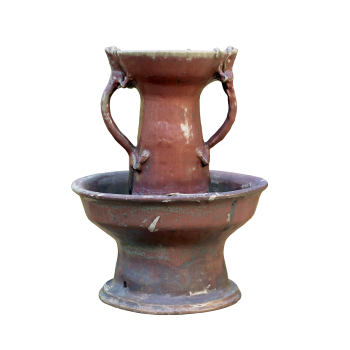
Blue and white jade teapot, spring vase, porcelain, antique vase

Blue and white jade teapot, spring vase, porcelain, antique vase

Bronze Statue of a Boxer at the National Museum of Rome

Bronze Statue of a Boxer at the National Museum of Rome

The statue depicts a boxer sitting down and resting for a moment in the midst of a fierce boxing match. He is an elderly boxer who has been through boxing matches for a long time. His image appears tired, and from his movements and expressions, he seems to lack confidence in whether he can win. However, he still shows great concern for the game. He exposes his solid muscles all over his body, although he is strong, he has a strong sense of not following his heart. Sculptor Apollonius displayed a high degree of realism in this work, with the human body's movements and bulging muscles conforming to the anatomy of the human body. Not only is the external form realistic, but the internal mental state is also extremely vivid, full of humanity and life.
Traditional Chinese pouring vessels and toasting cups

Traditional Chinese pouring vessels and toasting cups

Ancient Greek vase painting pottery with double ears, long neck, high vase

Ancient Greek vase painting pottery with double ears, long neck, high vase

Bronze square cauldrons from the early Western Zhou Dynasty collected by the Minneapolis Institute of Art

Bronze square cauldrons from the early Western Zhou Dynasty collected by the Minneapolis Institute of Art

Ding is a utensil used by ancient Chinese people in some places to cook and store meat, and is one of the most important bronze ware species in ancient times. The "ding" (cooking vessel) is considered by later generations to be the most representative of supreme power among all bronze vessels.
The sculpture of the Pacific god A'a, carved on the island of Lulutu in the Australian archipelago in the 16th century

The sculpture of the Pacific god A'a, carved on the island of Lulutu in the Australian archipelago in the 16th century

The A'a statue on Lulutu Island is a wooden sculpture of the A'a god, made on the Pacific island of Lulutu in the Australian archipelago. The production period may have been between 1591 and 1647. In the early 19th century, this sculpture was given to the London Missionary Society by islanders to commemorate their conversion to Christianity. Afterwards, it was brought back to the UK and exhibited at the British Museum. The image of A'a is one of the best surviving works of Polynesian sculpture, and according to Julie Adams, director of the Oceanian Collection at the British Museum, in the 21st century, the sculpture is considered an "international celebrity".
Minneapolis Museum of Art 13th Century Japanese Wood Carving Northern Heavenly King Vishamon Sky

Minneapolis Museum of Art 13th Century Japanese Wood Carving Northern Heavenly King Vishamon Sky

This is a late 13th century statue of the celestial Visharman, now in the Minneapolis Museum of Art. This statue is made of Japanese cypress wood, painted with color, gold foil, metal. It was created by Chang Qing, a famous Japanese sculptor of Buddha statues. Pishaman day is one of the four kings in Buddhism, guarding the north, driving out demons and protecting the world. He wore a heavily armored samurai with a spear and a small tower.
Kyoto National Museum Wooden Mask Red Ghost Mask

Kyoto National Museum Wooden Mask Red Ghost Mask

The red ghost mask is a mask used to perform ghost dances, usually held in shrines, temples and other religious places. Ghost dance is a ritual that can dispel evil spirits and bless peace. It is usually composed of ghost masks, ghost costumes, ghost props, etc. There are many styles of red ghost masks, some are human, some are animal-shaped, and some are weird. This mask is in the collection of the Kyoto National Museum. It is an animal-shaped red ghost mask with sharp teeth and fangs, as well as a long nose and eyebrows. The mask is carved out of wood.
Gustav Vasa's steel helmet at the Royal Swedish Armory Museum

Gustav Vasa's steel helmet at the Royal Swedish Armory Museum

It was made in 1540 in Germany, probably in Augsburg or Nuremberg, which was home to some of the most skilled armour makers of the time. The visor is the part that covers the face and was not originally part of the helmet, but is thought to be of the same period. This helmet is quite special-looking and is one of the few well-preserved items owned by King Gustav Vasa of Sweden. The helmet is currently on display at the Royal Swedish Armoury Museum, which is located in the Royal Palace in Stockholm and is one of the oldest museums in the world. The museum houses historical artifacts from the Swedish royal family and military.
Ancient Greek Antique Bronze Art Binaural Vase

Ancient Greek Antique Bronze Art Binaural Vase

The Victory Parade after the Battle of Aktime

The Victory Parade after the Battle of Aktime

This marble relief was part of a triumphal parade in Rome to commemorate Octavian's victory at the Battle of Aktim. The Battle of Aktia, a naval battle between the Roman Republic and the Ptolemaic dynasty of Egypt, took place on September 2, 31 BC, and was the last major battle in the Roman Civil War. Roman Commander Agrippa led 400 warships and fought Antony's 500 warships on the west coast of Greece. As a result, Antony's fleet was almost wiped out. The naval battle became the decisive battle of Antony's struggle against Octavian.
Marble relief "The Death of Mel Arg" at the City Museum in Brussels, Belgium

Marble relief "The Death of Mel Arg" at the City Museum in Brussels, Belgium

The Melleag of Death is a set of three marble reliefs created by the French sculptor Jacques Bergé (Jacques Bergé) at the end of the 19th century, depicting the life and death of Melleag in Greek mythology. These reliefs are "Melaag Kills the Wild Boar", "Melaag and Atalanta" and "The Death of Melaag", which respectively show the bravery, love and tragedy of Melaag. These reliefs are currently in the collection of the Brussels City Museum, located in the "" Royal Palace "" or "" Bakery "in the Grand Place of Brussels. The building itself is a historic museum.
Bust of Sir Robert Bruce Cotton

Bust of Sir Robert Bruce Cotton

Sir Robert Bruce Cotton (Sir Robert Bruce Cotton,1571-1631) was a British politician, ancient book collector and scholar. He founded the Cotton Library (Cottonian Library) and collected a large number of precious manuscripts and Documents have an important influence on British history and culture.
Ramses II Granite Head British Museum Collection

Ramses II Granite Head British Museum Collection

This statue depicts the 19th Dynasty Pharaoh Ramses II wearing a holy serpent crown and a Nimes turban. The statue was damaged by the time it was found, with the limbs and lower half missing. It is one of a pair of statues of Ramses originally located on the flank of the gate of the Temple of Lamesim, and the head of the other statue is still at the gate of the Temple of Lamesim. The statue was transported from Egypt to England in 1816 by the Italian explorer Giovanni Berzoni and acquired by the British Museum in 1821. It is now one of the representative artifacts of the British Museum, displayed in Hall 4.
Cambay Carved Tombstone British Museum Collection

Cambay Carved Tombstone British Museum Collection

A relief marble tombstone made in Kambe (found/acquired in Aden, Yemen), Gujarat, India, now at the British Museum, London. "The inscription includes blessings and Quranic verses in Arabic... the name of the deceased (Abu Hassan Ali ibn Osman) appears on the side of the panel......"
Stone oil lamp base unearthed at Broch of Gurness

Stone oil lamp base unearthed at Broch of Gurness

Broch of Gurness is an Iron Age village in the western Orkney Islands, Scotland, about 2,000 years old. This roughly chiseled lamp, once filled with oil, could once provide light from a slow-burning wick. Found in an Iron Age settlement Gurness of Broch.
Satyr and Nymph Statue at the British Museum in London

Satyr and Nymph Statue at the British Museum in London

This is a Roman sculpture found in Divoli, Italy, depicting a forest god holding a fairy, now in the British Museum in London.
A 17.14cm tall Japanese Satsuma ceramic vase

A 17.14cm tall Japanese Satsuma ceramic vase

A cream-colored Japanese pottery, produced in Satsuma, Kyushu, began in the late 18th century, with an exquisite cracked glaze and fine decorative patterns of color and gold. Satsuma Burning originated at the end of the 16th century. Satsuma ceramics include official kilns, folk kilns and imperial kilns, distributed in the southern part of Kyushu Island, Japan. In ancient times, it belonged to the state of Satsuma. The vase is painted with the Meiji period (1868-1912) colored enamel and gilded figures of everyday work, with a cock painted on the back amid blooming flowers and trees.
Cleveland Museum of Art Collection Black Pottery Neck Jars: Hercules and Nemeia Lions, Dionysus, Goat Gods and Fanatical Goddess

Cleveland Museum of Art Collection Black Pottery Neck Jars: Hercules and Nemeia Lions, Dionysus, Goat Gods and Fanatical Goddess

This Greek Athens pottery has a total height of 39.8cm and a diameter of 29cm. It was purchased by the Andrew R. and Martha Holden Jennings Foundation in 1970. On the front of the wine jar, Hercules, one of Greece's greatest heroes, is shown wrestling with a lion of Nemeia, who wears a lion's skin as a trophy for protection. Athena, the patron goddess of Hercules, stands with her nephew Iolaus (armed with the Hero's Stick). On the other side, a scene unrelated to the former is shown, depicting Dionysus, the god of wine, with the dancing fanatical goddess and the goat god.
"San Fernando Receives King Baeza's Embassy" Oil Painting

"San Fernando Receives King Baeza's Embassy" Oil Painting

The Embassy of King Baeza received in San Fernando is an oil on canvas painting by the Canary Islands painter Juan de Miranda in 1760. Dimensions: 130 x 174cm. The virtualisation of the painting is particularly interesting because the author painted a portrait of himself on the back of the canvas as a signature for the painting.
ancient chinese vase

ancient chinese vase

Japanese vase with lid

Japanese vase with lid

It is now in the National Gallery in Dresden, Germany.
Monument Rune Stone

Monument Rune Stone

Sculpture of the god Thoth

Sculpture of the god Thoth

Thoth, also translated as Thoth or Thoth, is the god of wisdom and the moon, the local god of Heliopolis, the inventor of words, the instrument of the gods, and is depicted in the Book of the Dead as the Statue Judge. Toth is often depicted as a heron head, with a name meaning and curved mouth reminiscent of a crescent moon. Sometimes, Tochow is also depicted as a baboon holding a crescent moon because baboons are nocturnal and quite intelligent. The model is a Thoth sculpture, made in 7-6 BC, now in the collection of the Minneapolis Institute of Art.